

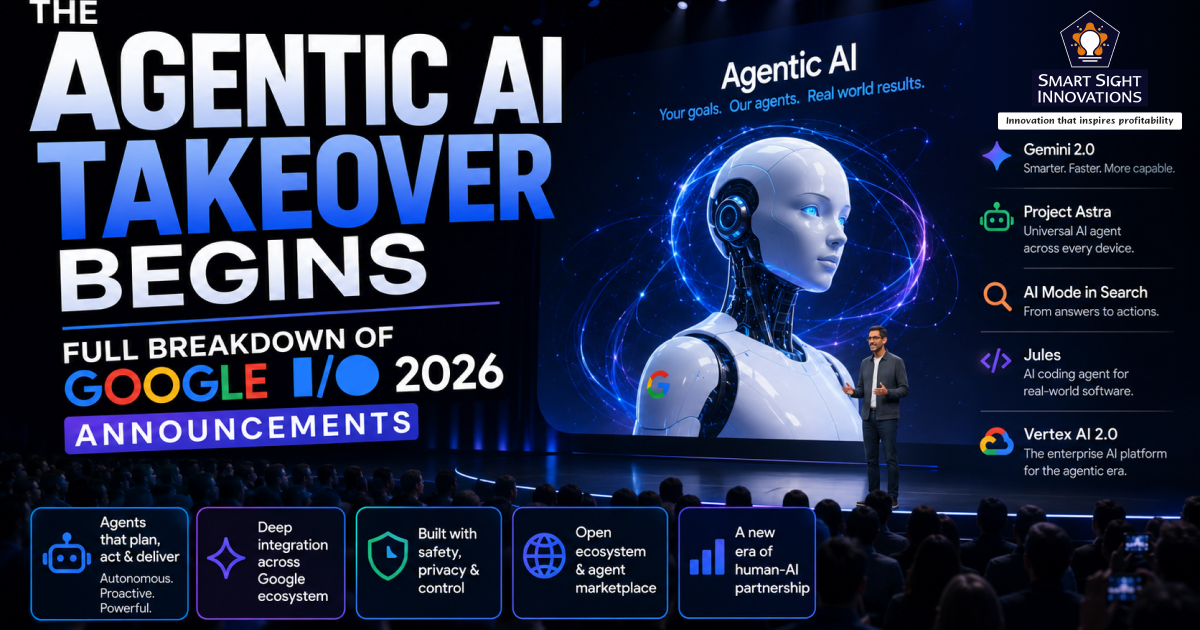
Google’s annual developer conference has always been the stage where the company reveals its boldest technological ambitions. But Google I/O 2026 represents a watershed moment — the definitive shift from AI (AI Software & AI Web) assistants that help you write, to AI (AI Software & AI Web) agents that act independently on your behalf.
With over 100 announcements spanning new AI (AI Software & AI Web) models, developer platforms, hardware, search reimagined, workplace tools, commerce capabilities, and scientific collaboration, Google painted a portrait of the “agentic era” where artificial intelligence doesn’t just respond to queries — it orchestrates complex workflows, anticipates your needs, and operates 24/7 without explicit instruction.
This exhaustive coverage captures the seismic announcements from May 19-20, 2026.
1. Google Search Reimagined: Biggest Update in 25 Years
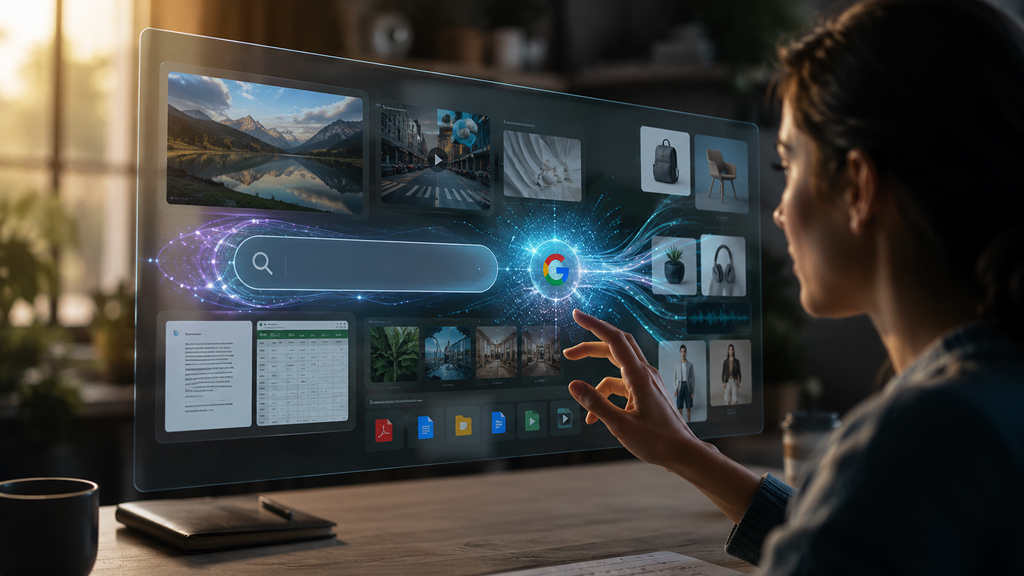
Search, Google’s cornerstone product with billions of daily users, received its most dramatic overhaul in over two decades. The changes aren’t cosmetic — they represent a fundamental reconception of what search means in the AI (AI Software & AI Web) age.
AI (AI Software & AI Web) Mode, Google’s dedicated AI (AI Software & AI Web) search experience, surpassed 1 billion monthly users before I/O 2026 even began. Now powered by Gemini 3.5 Flash globally, AI (AI Software & AI Web) Mode now supports complex agentic tasks including building custom dashboards, planning multi-leg travel itineraries, and executing research across diverse information sources — tasks previously requiring multiple specialized tools.
Search now supports multimodal input — text, images, files, videos, and Chrome tabs can all be included in a single search query. Google’s reasoning engine processes them collectively, understanding connections across media types. This represents a quantum leap from the single-query searches of previous generations.
2. Google’s Agentic AI (AI Software & AI Web) Era: A Fundamental Shift

Google CEO Sundar Pichai opened the I/O 2026 keynote with a clear message: the company has transitioned from AI (AI Software & AI Web) assistants to agentic AI (AI Software & AI Web) — autonomous systems that can navigate complex tasks independently across your entire workflow without constant human direction.
This philosophical shift represents the most significant pivot in Google’s AI (AI Software & AI Web) strategy since introducing Gemini itself. Agents differ fundamentally from chatbots. While traditional AI (AI Software & AI Web) responds when you ask it something, agents work proactively, continuously monitoring your tasks, remembering context from previous interactions, and taking actions on your behalf within parameters you define.
An agent doesn’t wait for you to ask — it anticipates needs, manages multiple steps simultaneously, and delivers results before you explicitly request them.
Google’s infrastructure processing these staggering token volumes relies on custom TPU chips and strategic partnerships. The scale enables Gemini deployment across 13 products with over a billion users each, with 5 products crossing the 3 billion user threshold. The Gemini app alone has more than doubled monthly active users in a year, now sitting at just under 900 million, while daily requests grew over seven times.
3. Gemini 3.5 Flash: The Breakthrough Model Powering the Agentic Era

At the heart of Google’s agentic revolution stands Gemini 3.5 Flash, the company’s newest generation model combining frontier-level intelligence with unprecedented speed and cost efficiency. Flash represents a paradigm shift in how AI (AI Software & AI Web) models balance capability against speed and expense.
Gemini 3.5 Flash Performance Metrics
- Outperforms Gemini 3.1 Pro on coding, agentic, and multimodal benchmarks
- 4x faster output token generation than comparable frontier models
- Cost less than half comparable frontier models while delivering equivalent intelligence
- Available today in Gemini app, Search, Google Antigravity 2.0, and Gemini API
- Already processing 3 trillion tokens daily internally across Google developer tools
The economics represent transformational savings. If large enterprises shifted 80% of their workloads to Gemini 3.5 Flash, Google estimates they’d collectively save over $1 billion annually.
For developers building agentic applications, Flash’s combination of speed and cost make complex agent architectures economically viable at scale—a critical enabler for the agentic era. Gemini 3.5 Pro, the flagship model, is currently in testing and arrives next month, promising even more powerful reasoning capabilities.
Meanwhile, Flash’s immediate availability demonstrates Google’s confidence and commitment to shipping frontier capabilities to developers and consumers on day one of the conference.
4. Gemini Omni: The Creative Generative Model Transforming Content Creation

Beyond pure reasoning, Google introduced Gemini Omni, a revolutionary generative model that can create anything from any input — starting with video as the initial application. Omni combines Gemini’s intelligence with Google’s generative models like Nano Banana and Veo, resulting in unprecedented creative capabilities.
Gemini Omni Flash’s immediate availability signals Google’s emphasis on creative capabilities alongside analytical ones. Demis Hassabis, Google DeepMind’s chief, emphasized that Omni’s trajectory extends beyond video toward systems that can generate any output format from any input type, positioning Google to compete across creative domains currently dominated by specialized models.
5. Google Antigravity 2.0: The Agent-First Development Platform

Google’s developer platform for building agentic applications received a comprehensive overhaul. Antigravity 2.0 is “unabashedly agent-first,” rebuilt from the ground up with agentic workflows as the primary use case rather than treating agents as an afterthought.
On stage, Google demonstrated Antigravity’s capabilities by building an entire operating system and then running Doom within it — a symbolic representation of the platform’s power. This wasn’t marketing theater, it genuinely illustrated how developers can orchestrate complex multi-step processes through Antigravity’s agent framework.
Managed Agents, accessed through the Interactions API and Google AI (AI Software & AI Web) Studio, represent a new abstraction layer. Developers can define agent behaviors through high-level specifications, and Antigravity handles the complex orchestration automatically. This democratization means developers without deep ML expertise can build sophisticated agents.
6. Android XR Intelligent Eyewear: Google’s Assault on Wearable Computing

Google’s direct entry into smart glasses marks the company’s most aggressive hardware announcement in years. Unlike Meta’s Ray-Ban smart glasses focused on cameras, or Apple’s Vision Pro’s immersive VR, Google’s intelligent eyewear emphasizes lightweight, always-on AI (AI Software & AI Web) assistance without pulling you out of the real world.
Hardware partnerships demonstrate Google’s commitment — Samsung and Qualcomm engineer the processors, Gentle Monster and Warby Parker design the frames, while XREAL contributes additional partnership capabilities. The partnerships signal confidence — Google isn’t building everything alone but orchestrating an ecosystem.
Gemini processes multimodal input from cameras, microphones, and environmental sensors, delivering context-aware assistance. The glasses represent Android XR’s first consumer hardware product, validating Google’s year-old commitment to extended reality as a core platform priority.
7. Google Workspace Agents: Collaborative AI (AI Software & AI Web) Across Docs, Gmail, and Keep

Google’s productivity suite received agentic capabilities transforming how teams create and collaborate. Agents now appear across Workspace products, handling everything from document creation to email composition.
Gmail gains voice capabilities allowing users to compose, send, and manage emails through natural conversation.
Users can voice-dictate complex emails with multiple recipients, conditions, and context—replacing tedious manual typing with conversational specification. Keep, Google’s note-taking app, similarly receives voice composition features, letting users capture thoughts through speaking rather than typing, with the agent organizing and structuring the raw input automatically.
8. Google Pics: The AI (AI Software & AI Web) Image Creation Tool Integrated into Workspace

Responding to DALL-E and Midjourney’s popularity, Google introduced Pics, a new Workspace application for creating and editing AI (AI Software & AI Web) images. Built on Google’s Nano Banana model, Pics emphasizes simplicity and integration.
Pics represents Google’s strategy of embedding creative AI (AI Software & AI Web) into productivity workflows rather than forcing users to switch between specialized applications. Marketing teams can create campaign images without leaving Docs. Educators can generate illustrations for presentations directly within their slides. The integration approach reduces friction and adoption barriers.
9. Universal Cart: Reimagining AI-Powered Commerce Across the Web

Google introduced Universal Cart, an intelligent shopping system operating across retailers, services, and merchants. Unlike Amazon’s ecosystem lock-in, Universal Cart works everywhere — reading product information from any website and managing purchases across multiple retailers simultaneously.
Two new protocols enable this ecosystem — the Universal Commerce Protocol allows retailers to expose product information in standard formats, and the Agents Payment Protocol lets AI (AI Software & AI Web) agents make purchases on your behalf using parameters you define (brand preference, price ceiling, delivery speed, etc.).
This transforms shopping from a manual process to an agentic workflow where Gemini handles routine purchasing while you focus on decisions requiring judgment.
10. Gemini Spark: The Personal AI (AI Software & AI Web) Agent for 24/7 Proactive Help

Spark represents a new class of AI (AI Software & AI Web) agent — a persistent system running continuously in Google’s cloud infrastructure, monitoring your tasks, remembering context, and taking actions without waiting for explicit instruction. Unlike traditional AI (AI Software & AI Web) chatbots that only work during active conversation, Spark operates 24/7.
It tracks information you’ve requested, monitors tasks you’re working on, and proactively delivers updates and suggestions. If you asked Spark about airline prices last Tuesday, it automatically notifies you when fares drop. If you’re tracking project deadlines, Spark reminds you of upcoming dates and suggests timeline adjustments when necessary.
11. Ask YouTube: Conversational Video Search and Discovery

YouTube, the world’s largest video platform with billions of users, gained agentic search capabilities. Ask YouTube lets users query the platform conversationally, seeking information, tutorials, and entertainment through natural language rather than keyword searches.
Users can ask complex questions like “Show me videos explaining this physics concept, but only from 2023 onward and prefer lectures under 10 minutes.” The agent understands temporal constraints, duration preferences, content type, and delivers curated results. Follow-up questions refine results further, with the agent remembering previous context.
These YouTube features are currently in testing with limited users. A broad rollout across the United States is expected in summer 2026 with international expansion slated later this year.
12. Android 17: The “Intelligence System” Platform Update

Android 17 (codenamed Cinnamon Bun) represents Google’s most AI-focused Android version, reframing the platform as an “intelligence system” where on-device AI (AI Software & AI Web) becomes as fundamental as the kernel.
Google emphasized on-device processing for sensitive operations — user data remains local, processing happens instantly, and privacy is preserved. This contrasts with cloud-based approaches, positioning Google’s strategy around local intelligence first, cloud augmentation second.
13. Google Photos Wardrobe Planning: AI (AI Software & AI Web) Fashion Assistant

Google Photos expanded into personal styling through AI (AI Software & AI Web) wardrobe management. The system pulls clothing items from your photo library, organizing them into a digital closet.
Users can mix items to create outfits, try them virtually with digital avatars to see how they’ll look, and receive styling recommendations based on weather, occasion, and personal preferences. This transforms photo libraries into functional fashion management systems.
14. macOS Gemini App: Voice Control and Native Integration

Mac users gained native Gemini integration. Selecting images and documents in Finder, then pressing Function key activates voice commands. A demo showed sending an email to a dog kennel with the pet’s information and image, with details pulled automatically from Finder and email drafted using Gmail in Chrome.
Voice support and Gemini Spark integration arrive in the Gemini Mac app this summer, bringing parity with iOS while respecting macOS design conventions.
15. Regional Dialect Voice Options: Personalized Gemini Accents

Google expanded Gemini’s voice capabilities to support regional dialects and accents. Demonstrations included a Liverpudlian accent alongside standard options, representing Google’s commitment to voice AI (AI Software & AI Web) reflecting global diversity rather than imposing homogenized speech.
16. Apple Partnership Confirmed: Gemini Powering Enhanced Siri in 2026

Google confirmed its partnership with Apple, announcing that Gemini will power a new, more personalized version of Siri launching later in 2026. This represents Google’s most direct integration into Apple’s core platform, with Siri on 2 billion+ iOS devices gaining access to Gemini’s reasoning and capabilities.
Strategic Significance
This partnership validates Google’s Gemini as the preferred AI (AI Software & AI Web) engine even within Apple’s fiercely proprietary ecosystem. Siri’s limitations have long frustrated Apple users; Gemini integration represents a significant capability uplift while acknowledging Google’s technical leadership in conversational AI.
17. Pricing Restructure: AI (AI Software & AI Web) Ultra at $100/Month, Pro Tier Reduction

Google announced significant pricing changes for its AI (AI Software & AI Web) subscription tiers, dramatically lowering barriers to advanced AI (AI Software & AI Web) capabilities while restructuring usage limits.
The $100 pricing for Ultra represents aggressive market positioning — matching or undercutting competing AI (AI Software & AI Web) services while including 5x higher usage limits than the previous $250 tier. Moving Pro to $200 signals confidence in Flash’s capabilities relative to Pro-tier models from competitors.
18. Gemini for Science: AI (AI Software & AI Web) as Research Collaborator
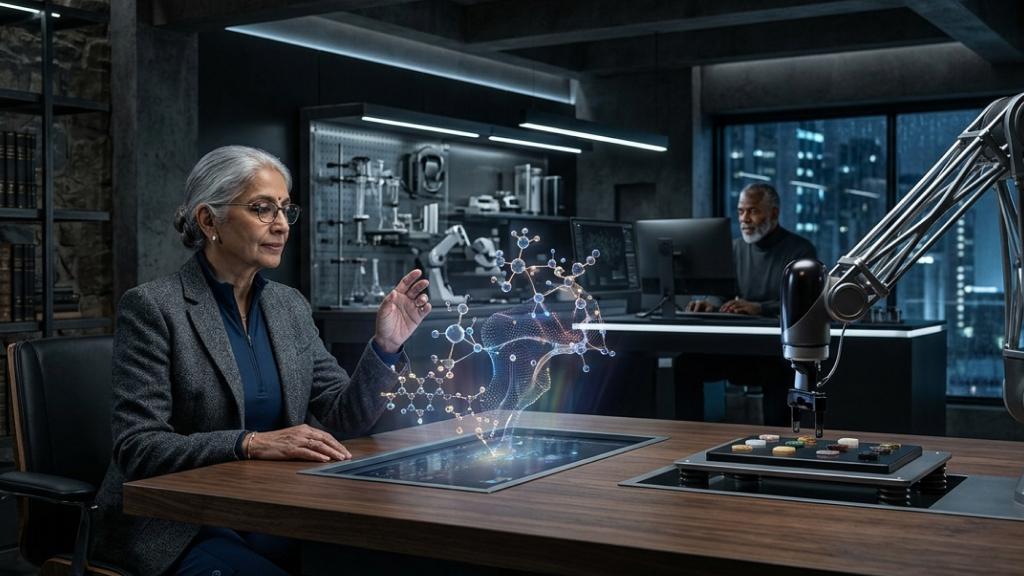
Google extended Gemini into scientific research through dedicated science tools and a “Co-Scientist” collaborative AI (AI Software & AI Web) research partner. This signals Google’s belief that AI (AI Software & AI Web) should accelerate discovery and innovation at the highest levels.
Google established dedicated pilots with leading scientific conferences (ICML, STOC, NeurIPS) to develop pioneering tools for agentic peer review and scientific validation. These pilots explore AI’s role not just in conducting research but in advancing research methodology itself.
19. Digital Watermarking Expansion: SynthID and C2PA Content Credentials

Responding to growing concerns about AI-generated content authenticity, Google expanded digital watermarking technologies for identifying AI-created media and detecting AI-based edits of real content.
SynthID — Google’s imperceptible watermarking technology — is being adopted by major AI (AI Software & AI Web) companies including OpenAI, Kakao, and ElevenLabs. More content across the web will soon carry these invisible watermarks, enabling detection systems to identify AI-generated audio, video, and images with high confidence.
C2PA Content Credentials provide explicit metadata about content creation and editing history. Gemini and Chrome will integrate C2PA checking, allowing users to right-click images and ask whether they’re AI-generated or edited with AI. This transparency supports the digital literacy necessary as AI-generated content becomes ubiquitous.
The Agentic Era Officially Begins

Google I/O 2026 marks the official transition point where artificial intelligence evolved from an assistant responding to queries into agentic systems that work autonomously, continuously, and proactively.
With over 100 announcements spanning new models (Gemini 3.5 Flash, Gemini Omni), developer platforms (Antigravity 2.0), hardware (Android XR glasses), reimagined products (Search), new categories (Universal Cart, Spark, Pics), and strategic partnerships (Apple), Google articulated a comprehensive vision where AI (AI Software & AI Web) doesn’t augment human capability — it fundamentally reshapes how work, discovery, creation, and commerce operate.
The scale is staggering — 3.2 quadrillion tokens monthly, 13 products with billion+ users, nearly 900 million Gemini app users.
The ambition is clear — Gemini should become as embedded in digital life as Google Search currently is.
The timeline is aggressive — most features rolling out within weeks or months, not years.
For developers, the message resonated loudly — the tools to build sophisticated agents are now accessible, affordable, and production-ready.
For consumers, the implications are equally significant — AI (AI Software & AI Web) will increasingly anticipate needs rather than wait for instruction. For enterprises, the challenge becomes managing agentic AI (AI Software & AI Web) within governance, compliance, and ethical frameworks.